


ROLE
Project Lead and Lead Gameplay Programmer
DESCRIPTION
Echoes of a Silent Garden is a VR psychological horror experience with a haunting hand-drawn black-and-white art style. In the game, you play as Chrys, the daughter of a botanist whose obsession with reviving a dying world unleashes a malevolent force that consumes your sister. As the remnants of your once-thriving life crumble around you, you will need to navigate this eerie world to save your family before it’s too late.
YEAR
2024 - 2025
GENRE
Psychological Horror
Engine and Add ons
Unity Engine
FMOD
Hurricane VR (V1)
AutoHand (V2)
PLATFORM
Meta Quest 3

Trailer
Contributions
Team Lead
-
Led a cross-discipline team of 11 Peers
-
Created a Game Design Doc
-
Led bi-daily meetings
-
facilitated communication between the different teams.
-
Communicated progress with team leads and advisors
-
Assisted in approving assets for implementation
-
Created Presskit and steam assets
Contributions information
Main Gameplay Programmer
-
Created an advanced Goal-Oriented Action Planning (GOAP) based AI System
-
Modular System
-
Hearing Detection
-
Proximity Detection
-
Sound Detection
-
Flashlight awareness integration
-
-
-
Optimized project for Standalone VR
-
Multi-scene workflow
-
Culling Objects
-
-
Implementation of sound using FMOD
-
Implementation of Autohand VR Physics System
Dev Logs
Click the button below to view the full Bluesky thread
GOAP AI System
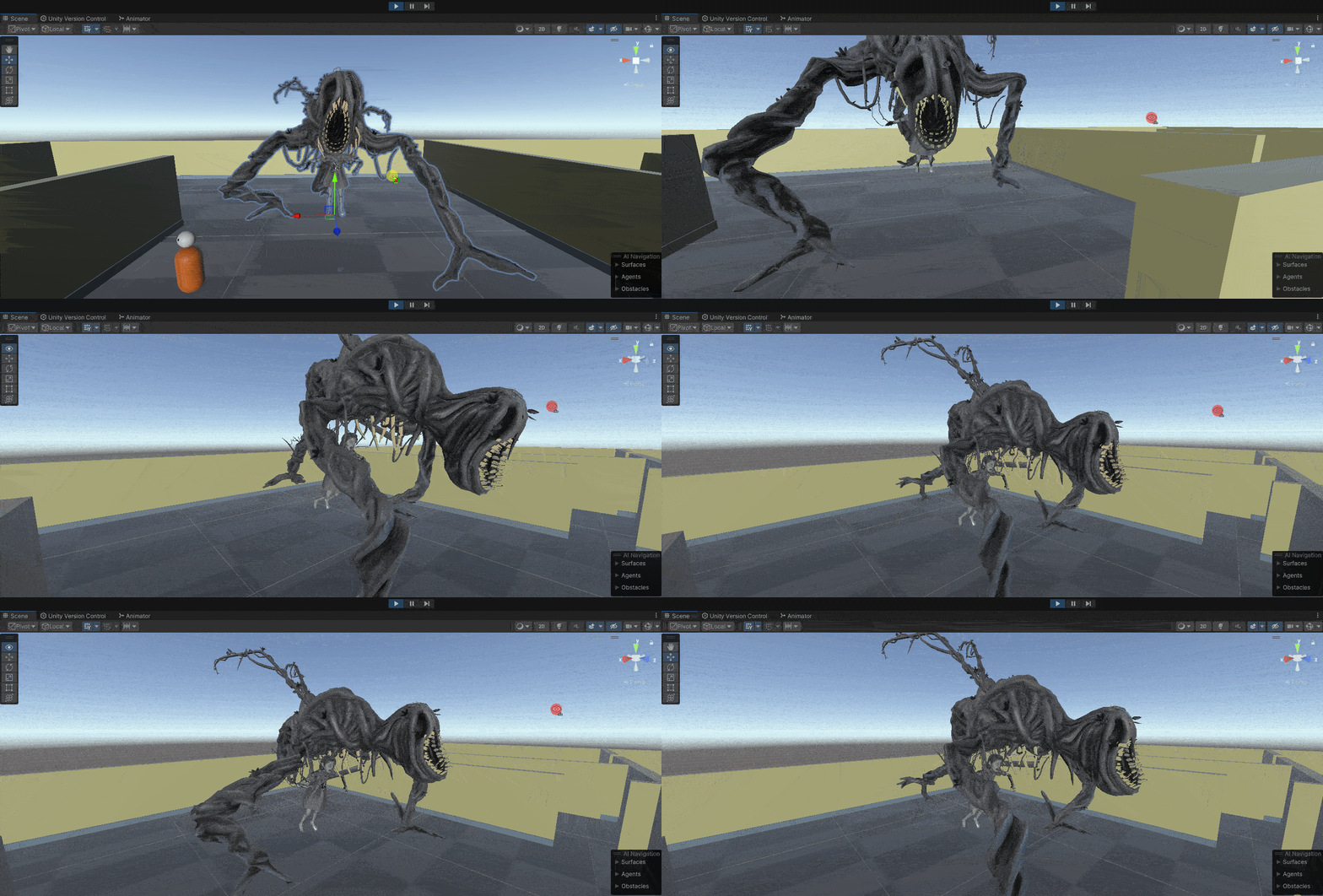
-
Goal-Oriented Action Planning (GOAP)–based AI architecture
-
Multi-stage detection system progressing from unaware to fully engaged
-
Reactive behavior driven by perception rather than scripted states
-
Hearing-based awareness integrated into AI decision-making

Extended NavMesh destination selection with obstacle checks and path validation to prevent unreachable targets in tight spaces.
This system represents the primary gameplay AI framework for the project and was designed to support a reactive creature that responds dynamically to player behavior. I implemented a GOAP-based architecture to allow the AI to evaluate goals and select actions based on changing world state rather than relying on fixed state machines.
The creature’s awareness is governed by a five-stage detection model, ranging from fully unaware to actively engaged. Detection values increase based on player actions and proximity, with hearing serving as a primary sensory input. As detection escalates, the AI re-evaluates goals and behaviors in real time, allowing it to transition naturally between investigation, searching, and pursuit.
Player-Driven Detection & Risk–Reward Mechanics

Gameplay-driven AI detection via flashlight noise, overcharge events, and hearing-based perception.
This system ties player interaction directly into AI perception through sound. Cranking the flashlight increases visibility but also raises the player’s detection value, emitting sound events that the AI can hear. Overcharging the flashlight triggers a loud audio spike that immediately reveals the player’s location, creating a deliberate risk–reward decision during exploration.
AI Navigation System
AI navigation refinement demonstrating wall avoidance and reliable target selection for a large character in constrained environments.
(Gameplay footage captured during development)
-
Facing correction using vector dot-product alignment checks
-
Wall avoidance via forward raycasts and directional steering
-
Validation of navigation targets using spatial overlap tests
-
Reliable AI movement for oversized characters in constrained spaces
Technical Overview
This navigation system builds on a NavMesh Agent foundation and addresses issues caused by character scale in tight level geometry. Because the AI character frequently clipped into walls or selected unreachable destinations, I implemented additional spatial checks to improve the reliability and readability of movement.
To ensure reliable movement, I corrected facing direction and wall collisions using forward raycasts combined with vector dot-product alignment checks between the character’s facing direction and target direction. Movement was only committed when directional alignment was valid, reducing erratic turning and wall-hugging behavior.
I also implemented validation checks for randomly generated navigation points using a sphere-overlap test and obstacle-layer filtering. This prevented targets from spawning beneath or inside level geometry, eliminating cases where the AI selected unreachable destinations.
Optimization
Video demonstration of occlusion culling reducing off-screen and obstructed geometry.

Primary texture atlas containing approximately 80% of in-game assets
-
Performance optimization for standalone VR hardware
-
Use of occlusion culling to reduce overdraw and unnecessary rendering
-
Texture atlasing and transparency reduction to improve GPU efficiency
-
Successful deployment to Quest 3 at a stable 90 FPS using Android API
Technical Overview
I was responsible for optimizing the project to meet the performance requirements of standalone VR on Quest 3. Because the target platform has strict GPU and CPU constraints, I focused on reducing rendering cost while preserving visual clarity and gameplay readability.
To minimize overdraw and unnecessary draw calls, I implemented occlusion culling to prevent off-screen and obstructed geometry from being rendered. As a technical lead, I advocated using texture atlases to reduce material count. I then integrated the atlased assets provided by the environment team into the material pipeline, verified rendering configurations, and resolved transparency and double-sided rendering issues to improve batching efficiency and overall performance.
These changes resulted in a stable 90 FPS experience on Quest 3 and enabled successful deployment to a standalone headset using the Android API, meeting VR comfort and performance requirements established by Meta
Production Debugging Case Study – GDC Showcase Preparation
Context
Four days prior to a scheduled GDC showcase, the project experienced severe and unexpected performance degradation that made it unsuitable for public demonstration.
Problem
Frame rate dropped significantly on target hardware, despite previously stable performance. Initial profiling did not reveal an obvious single bottleneck, and the issue appeared inconsistently across scenes.
Approach
To isolate the problem, I duplicated the project into a clean Unity environment and rebuilt the content incrementally, repeatedly testing performance as systems and assets were reintroduced. This process was repeated multiple times to rule out project corruption and identify configuration-level issues rather than gameplay logic errors.
Root Cause & Resolution
The performance issue was ultimately traced to a texture atlas containing foliage materials with transparency, where double-sided rendering had been unintentionally enabled. Because this atlas represented a large portion of visible geometry, the configuration dramatically increased overdraw and fill-rate cost on standalone VR hardware. Disabling double-sided rendering immediately restored stable performance.
Outcome
The project was stabilized and successfully showcased at GDC as part of the SCAD booth. Performance met target frame-rate requirements, and the experience was demonstrated reliably throughout the event.
FMOD Integration

FMOD event timeline showing layered chase music controlled by gameplay-driven detection parameters.
-
Gameplay-driven audio integration using FMOD
-
Dynamic music layering based on AI detection state
-
Real-time parameter control driven by gameplay systems
-
Tension scaling inspired by asymmetric horror design pattern

Gameplay-driven FMOD parameter updates, smoothing detection and distance values to control dynamic music layers.
Technical Overview
I implemented a dynamic music system using FMOD that responds to enemy awareness and player detection levels. As a creature’s detection value increases, additional musical layers are introduced in real time, increasing tension and signaling threat escalation to the player.
The system was designed to remain tightly coupled to gameplay state rather than scripted triggers. Detection values are passed as parameters to FMOD, allowing the music to evolve smoothly as AI awareness changes, rather than switching abruptly between tracks. This approach helped reinforce player feedback and atmosphere without requiring additional UI elements.
Showcase Recognition and Industry Feedback
GDC 2025


Showcase Experience
A demo was presented continuously to attendees, including industry professionals, developers, and students. The team focused on delivering a stable, polished vertical slice that clearly communicated core mechanics, atmosphere, and pacing within a short play session.
Industry Exposure
Through existing connections with Unity, the team was invited to attend the Unity Education Mixer, providing opportunities to discuss the project with developers and educators from across the industry. Player reactions during the demo helped validate the effectiveness of the game’s tension and moment-to-moment gameplay.
The Rookies

Recongnition
The project was selected as a finalist in the Immersive category for The Rookies, recognizing the quality of its interactive design, technical execution, and overall presentation among international student submissions.
Video Renders


